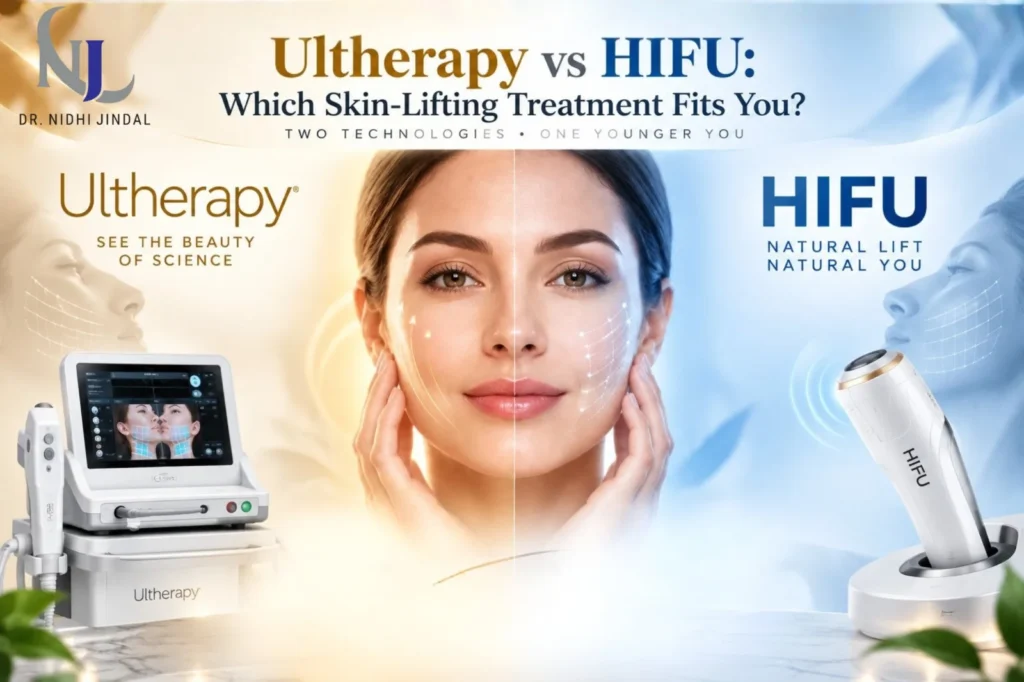
Want firmer, lifted-looking skin? Ultherapy and HIFU are popular non-surgical treatments that use focused ultrasound energy to target deeper tissue and encourage collagen remodeling. Although they share similarities, their technologies, treatment approaches, depth, and clinical applications can differ. Understanding Ultherapy vs HIFU for facial lifting can help you discuss realistic goals and suitable options with a qualified aesthetic doctor from Best Dermatologist in Newtown, Kolkata.
Yes, both treatments can support skin tightening.
However, Ultherapy and HIFU should not be considered identical procedures. Both use focused ultrasound energy, but treatment platforms, energy delivery, treatment depths, protocols, and clinical indications can vary.
For people researching a HIFU skin tightening clinic near me, understanding these differences is more useful than choosing a treatment based solely on popularity.
Ultherapy is a branded microfocused ultrasound treatment designed to deliver controlled ultrasound energy to targeted tissue layers. It is commonly used for non-surgical lifting and tightening.
HIFU, or High-Intensity Focused Ultrasound, is a broader technology category. Aesthetic HIFU systems use focused ultrasound energy at selected depths to create controlled thermal effects that may stimulate collagen remodeling.
Therefore, comparing Ultherapy vs HIFU for facial lifting requires looking at the specific HIFU device, treatment protocol, target area, and individual skin characteristics.
The biggest difference is that Ultherapy is a specific branded treatment platform, while HIFU describes a broader ultrasound-based technology.
| Feature | Ultherapy | HIFU |
| Technology | Microfocused ultrasound technology | High-Intensity Focused Ultrasound |
| Treatment type | Non-surgical | Non-surgical |
| Main aesthetic goal | Lifting and tightening | Tightening and lifting |
| Energy | Focused ultrasound | Focused ultrasound |
| Treatment depth | Device-specific targeted depths | Varies by device and cartridge |
| Imaging | Certain systems provide real-time visualization | Depends on the device |
| Treatment protocol | Platform-specific | Device and practitioner-specific |
| Suitable areas | Selected facial and neck areas | Face, jawline, neck and other approved areas depending on device |
| Results | Gradual collagen remodeling | Gradual collagen remodeling |
| Downtime | Usually minimal | Usually minimal, depending on treatment |
| Best approach | Individual assessment | Individual assessment |
Featured-snippet takeaway: Ultherapy is a particular ultrasound treatment platform, whereas HIFU is a broader category of focused ultrasound technology. Neither should automatically be considered superior for every patient.
Both can stimulate collagen remodeling through controlled ultrasound energy.
Focused ultrasound delivers energy beneath the skin’s surface. The resulting thermal effect can trigger a wound-healing response and encourage tissue remodeling.
Over time, this process may contribute to:
However, collagen response varies between individuals. Age, degree of laxity, skin condition, treatment settings, lifestyle, and the selected device can influence outcomes.
Importantly, these treatments do not create an instant replacement for surgical lifting. Their effects generally develop progressively as collagen remodeling occurs.
There is no universal answer to “Is Ultherapy better than HIFU for facial lifting?”
The appropriate option depends on several factors, including:
Someone with mild facial laxity may have different treatment needs from someone with more pronounced tissue laxity. Similarly, two HIFU devices may not deliver identical treatment experiences or results.
That is why a professional consultation should come before selecting a treatment.
Aesthetic HIFU may be considered for selected patients who want non-surgical improvement in areas affected by mild to moderate laxity.
Depending on the device and clinical protocol, treatment may focus on:
However, HIFU is not appropriate for every concern. It does not replace treatments specifically designed for pigmentation, active acne, significant volume loss, or severe skin laxity.
A proper assessment helps identify whether ultrasound tightening addresses the actual concern.
1. Treatment objective
First, identify whether your primary goal is tightening, lifting, contour definition, or overall facial rejuvenation.
2. Skin laxity
The degree and location of laxity can influence which treatment approach may be considered.
3. Device technology
“HIFU” does not refer to one universal machine. Different platforms may use different cartridges, depths, energy settings, and treatment protocols.
4. Practitioner expertise
Treatment planning matters. Correct energy selection, depth, treatment pattern, and anatomical understanding can influence both safety and results.
5. Expected downtime
Both approaches are generally positioned as non-surgical treatments with limited downtime, but temporary tenderness, redness, swelling, sensitivity, or other effects can occur.
6. Long-term expectations
Collagen remodeling takes time. Results should therefore be assessed progressively rather than immediately after treatment.
Choosing a HIFU Facial Treatment Doctor in Newtown, Kolkata involves more than finding a clinic that offers the procedure.
A qualified aesthetic dermatologist can assess:
This individualized approach can reduce the risk of choosing a treatment simply because it is trending online.
Dr Nidhi Jindal can provide a dermatologist-led assessment for individuals considering non-surgical facial rejuvenation. A consultation can focus on the patient’s skin condition, aesthetic concerns, treatment expectations, and suitability for procedures such as HIFU.
From an E-E-A-T perspective, patients should look for a qualified medical professional who can explain the technology, discuss potential benefits and limitations, identify contraindications, and provide realistic expectations rather than promising guaranteed results.
If HIFU appears appropriate after assessment, the treatment plan can then be individualized according to the facial area, degree of laxity, and selected technology.
For people searching for the Best HIFU Facial Treatment Doctor in Newtown, Kolkata, a consultation with Dr Nidhi Jindal can help clarify whether HIFU aligns with their specific skin-tightening goals.
Before you book HIFU facial tightening consultation, consider asking:
These questions can help you make a more informed decision.
Rather than asking which treatment is universally better, consider the treatment context.
| Goal | What to discuss with your doctor |
| Mild facial laxity | Whether ultrasound tightening is appropriate |
| Jawline definition | Target area and treatment depth |
| Neck tightening | Device suitability and anatomical considerations |
| Non-surgical lifting | Expected degree of improvement |
| Collagen stimulation | Treatment mechanism and timeline |
| Minimal downtime | Expected post-treatment effects |
| Personalized treatment | Device, settings, and practitioner expertise |
This approach supports informed treatment selection without assuming that one technology works equally well for every person.
When appropriately selected and performed, HIFU may offer several advantages:
Nevertheless, outcomes vary. A consultation is important because a treatment that works well for one patient may not address another patient’s primary concern.
Yes. Neither treatment should be presented as a universal solution for facial aging.
Potential limitations include:
Consequently, realistic expectations are an important part of aesthetic treatment planning.
HIFU and Ultherapy are non-surgical approaches, whereas a facelift is a surgical procedure designed to reposition and remove selected tissues.
The choice depends on the individual’s anatomy, degree of laxity, goals, medical suitability, and expectations.
Someone seeking a modest, non-surgical improvement may discuss ultrasound-based treatment. Someone with substantial tissue laxity may require evaluation for other approaches.
Therefore, comparing procedures should focus on individual treatment goals rather than assuming that a non-surgical procedure can reproduce surgical results.
If you are noticing mild facial or neck laxity and prefer to explore non-surgical options, you may consider consulting a qualified dermatologist or aesthetic physician.
However, avoid choosing a clinic solely because it advertises the lowest price or promises dramatic results. Check our youtube link: https://www.youtube.com/shorts/3wC017tzdO4
Instead, look for:
These factors can support a safer and more informed treatment journey. Check Patient’s Testimonial click: https://shorturl.at/sqW9y
Ultherapy and HIFU share the use of focused ultrasound energy, yet they are not interchangeable terms. Ultherapy represents a specific treatment platform, while HIFU covers a broader range of technologies. Therefore, the right choice depends on your skin condition, treatment goals, device, and professional assessment. If you are considering non-surgical facial lifting, speak with Dr Nidhi Jindal to develop a realistic, personalized treatment plan. If Patient’s willing to visit our area click the map: https://maps.app.goo.gl/pU16wraEKQi1yB6A7
Is Ultherapy better than HIFU for facial lifting?
Not necessarily. Ultherapy is a specific branded ultrasound treatment platform, while HIFU describes a broader technology category. Suitability depends on the patient’s skin laxity, treatment goals, device, and professional assessment.
How do Ultherapy and HIFU stimulate collagen production?
Both use focused ultrasound energy to create controlled thermal effects in targeted tissue. This can initiate a healing and remodeling response that may encourage collagen-related changes over time.
Is HIFU good for facial skin tightening?
HIFU may help selected patients with mild to moderate skin laxity. Results depend on the device, treatment settings, individual anatomy, skin condition, and degree of laxity.
How long does HIFU take to show results?
HIFU results generally develop gradually rather than appearing immediately. Collagen remodeling takes time, so your doctor can explain an appropriate timeline based on your treatment and skin condition.
Does HIFU permanently tighten the skin?
No cosmetic skin-tightening treatment can stop natural aging permanently. HIFU may provide gradual improvement, but skin changes continue over time.
Can HIFU replace a facelift?
HIFU does not reproduce the tissue repositioning achieved through facelift surgery. It may be considered for selected individuals seeking a non-surgical approach to mild or moderate laxity.
How do I choose a HIFU skin tightening clinic near me?
Look for a qualified medical practitioner, appropriate patient assessment, transparent information about the HIFU device, realistic expectations, and individualized treatment planning.
Should I book a HIFU facial tightening consultation before treatment?
Yes. A consultation allows the doctor to assess your skin, discuss your goals, identify suitability, explain possible benefits and limitations, and determine whether HIFU or another treatment is more appropriate.